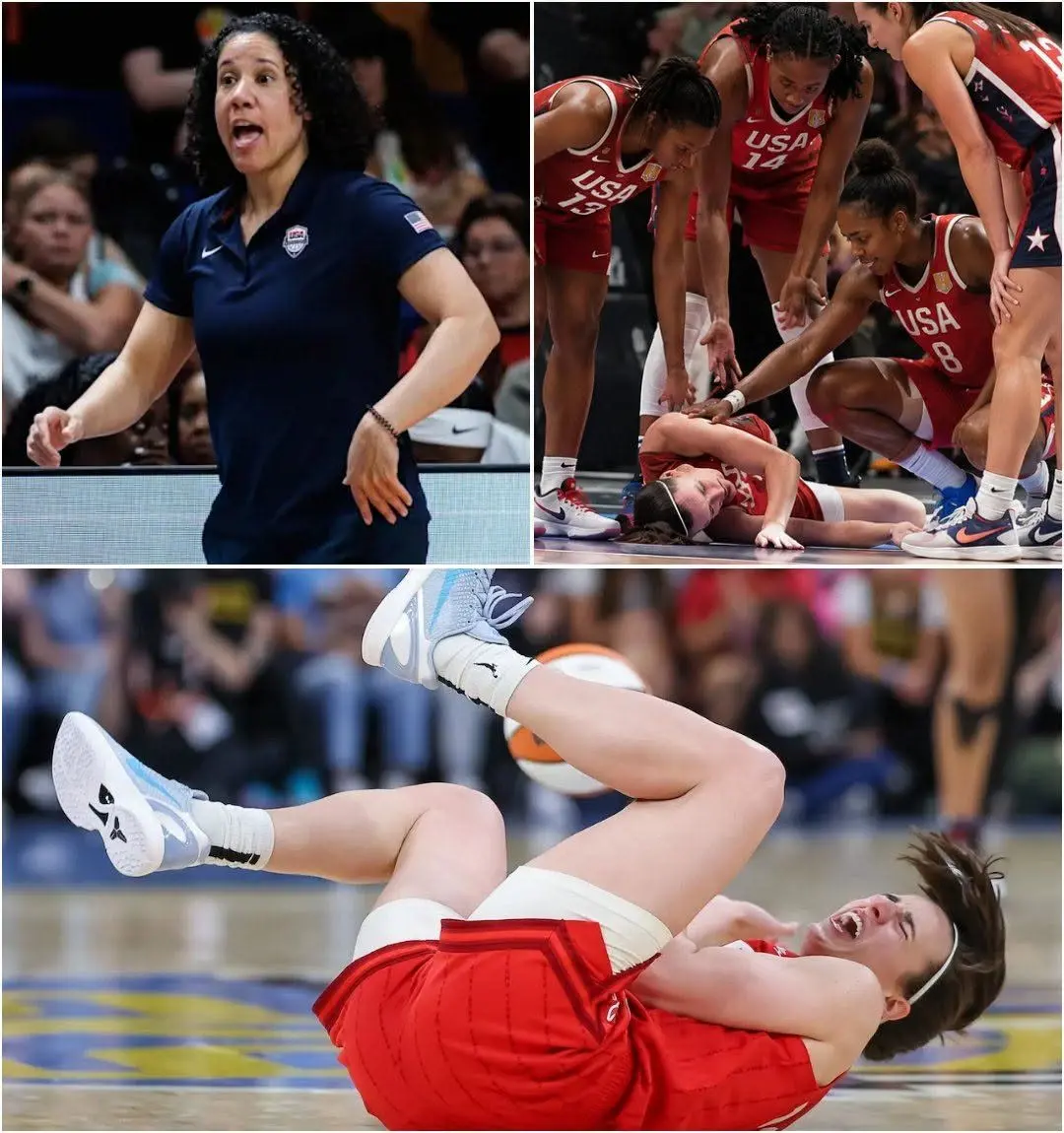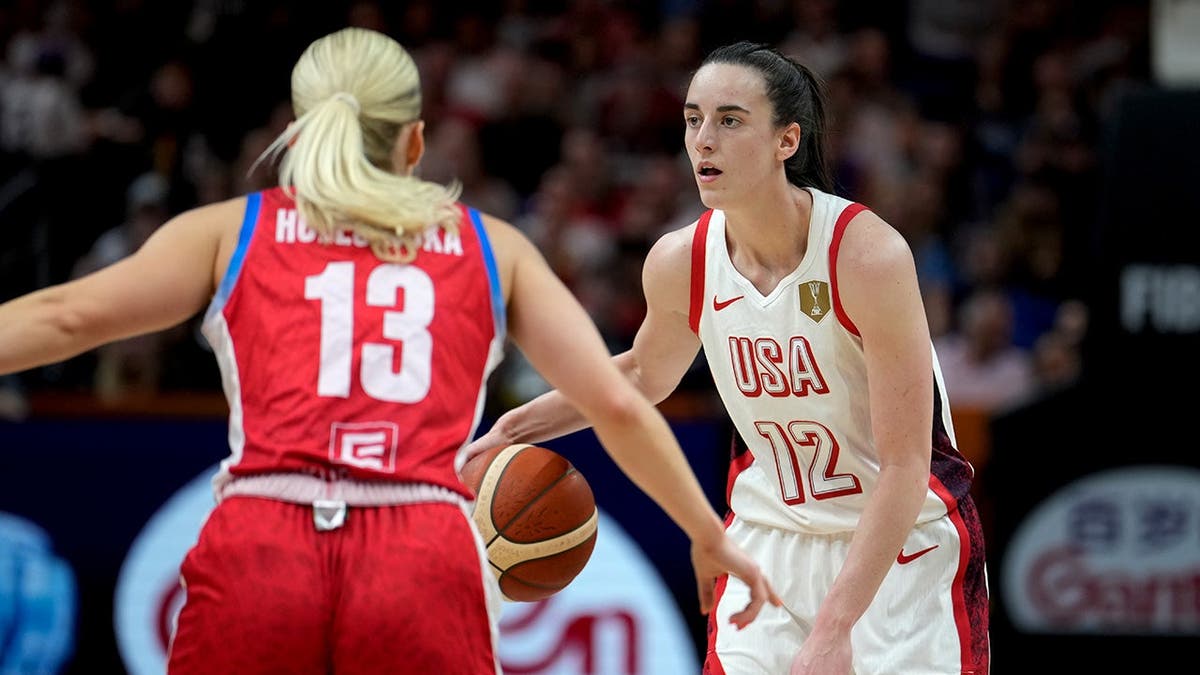
🚨🏀 CAITLIN CLARK’S LIMITED MINUTES HAVE BECOME TEAM USA’S BIGGEST DEBATE — IS KARA LAWSON SAVING A SECRET WEAPON OR LEAVING ONE OF BASKETBALL’S MOST DANGEROUS PLAYMAKERS ON THE BENCH TOO LONG? 👀🇺🇸🔥
Every Team USA victory should theoretically make the conversation easier.
Instead, Caitlin Clark's role has ensured that one question refuses to disappear.
Should she be playing more?
The debate has followed the Americans throughout the tournament because Clark occupies an unusual position. She is simultaneously one of the most recognizable basketball players in the world and a member of an American roster deep enough that even elite players must accept reduced roles.
For head coach Kara Lawson, that creates a basketball problem rather than a popularity contest.
Her responsibility is not to satisfy social media.
It is to win.
But Clark possesses skills that make the discussion difficult to dismiss.
Her shooting range can change defensive positioning before she ever touches the ball. Her passing can transform an ordinary rebound into an immediate scoring opportunity. Her pace forces defenders to make decisions before they are completely organized.
Those are valuable weapons in international basketball.
And when Clark spends extended stretches watching from the sideline, supporters naturally wonder whether Team USA is leaving something on the table.
The simplest argument for more Clark minutes begins with space.
Basketball is fundamentally a game of geometry.
Move one defender several feet away from the basket and everything else can change.
Clark's reputation as a deep shooter means defenders cannot casually retreat under screens or give her comfortable room above the arc.
Even when she is not shooting particularly well, opponents know what can happen if she suddenly finds rhythm.
That fear has value.
A defender who steps higher creates more room behind her.
A second defender who shades toward Clark may leave another player with space.
A big who moves farther from the rim can create a driving lane.
This is what coaches mean when they talk about gravity.
Clark can influence a possession without recording anything in the box score.
Then there is the passing.
Clark sees transition opportunities remarkably early.
Sometimes the most important part of one of her assists occurs before television cameras have fully shifted toward the offensive end.
She sees a teammate running.
She recognizes the defensive angle.
The ball is gone.
That style can be especially useful when Team USA's half-court offense becomes stagnant.
Instead of attacking five organized defenders possession after possession, Clark can create opportunities before the defense establishes itself.
That sounds like an obvious reason to increase her minutes.
But international tournament basketball is rarely that simple.
Lawson has an extraordinarily deep roster.
Minutes given to Clark must come from someone else.
Every lineup choice involves a tradeoff.
Maybe another guard offers stronger point-of-attack defense.
Maybe a veteran provides greater familiarity with a specific coverage.
Maybe Lawson wants more size.
Maybe she prefers a certain combination because it has developed better chemistry.
Fans see the player entering and leaving the game.
Coaches evaluate hundreds of possessions from practices, film sessions and previous matchups.
That does not make coaches immune from criticism.
It does mean rotation decisions usually involve more variables than one player's offensive upside.
There is also a fundamental difference between asking whether Clark deserves more minutes and arguing that Team USA cannot succeed without her.
Those are not the same claim.
The United States has enough talent to win games through multiple styles.
That depth is precisely why Lawson can use Clark selectively.
But the closer the competition becomes, the more interesting the question gets.
Against an overmatched opponent, almost any high-level American combination may create separation.
Against an elite opponent in an elimination game, one possession can decide everything.
That is when unique skills become particularly valuable.
Clark's skill set is undeniably unique.
Few players can combine her passing vision with her willingness to shoot from extreme distance.
Few can make a crowd react simply by crossing half court with the basketball.
And few can turn two consecutive possessions into a sudden momentum swing as quickly.
That is why some fans are less interested in whether Clark starts and more interested in whether she finishes.
Starting lineups carry prestige.
Closing lineups decide games.
A player can begin on the bench and still be one of the five most important players during the final four minutes.
If Clark is creating advantages, the meaningful question becomes whether Lawson is willing to ride that momentum regardless of the rotation originally written on the coaching board.
That is where coaching becomes situational.
Plans matter.
So does recognizing when the game is telling you to abandon the plan.
If Clark hits two deep threes and immediately forces the defense to change, taking her out simply because the substitution schedule says so could become difficult to justify.
Conversely, if another lineup is defending brilliantly and controlling the game, changing it merely because fans want Clark on the floor would make equally little sense.
The scoreboard has to matter more than the narrative.
That distinction gets lost easily because Clark creates an extraordinary amount of attention.
Every substitution involving her becomes content.
Every missed shot becomes debate.
Every assist becomes evidence for someone arguing that she should play more.
Every turnover becomes evidence for someone arguing the opposite.
That environment makes reasonable basketball discussion difficult.
Clark does not need to dominate every possession to influence the game.
Nor does every minute she spends on the bench represent disrespect.
The interesting question is optimization.
How can Team USA maximize what she does differently?
One answer may be using her as an offensive accelerator.
Bring her into the game when the pace has slowed.
Allow her to attack a second unit.
Surround her with runners and shooters.
Let her stretch the defense.
Force the opponent to adjust.
Then Lawson can decide whether the resulting lineup deserves to remain together.
There is strategic value in bringing a player of Clark's ability off the bench.
Opponents spend the opening minutes adjusting to one style, then suddenly encounter another.
The tempo changes.
The passing angles change.
The defensive pickup point changes.
The game feels different.
In that sense, Clark can function less like a traditional reserve and more like a tactical weapon.
But that approach only works if the weapon receives enough time to matter.
Basketball rhythm is real.
A shooter may need several possessions to settle.
A point guard needs time to understand how the defense is reacting.
Short, fragmented appearances can make it difficult for any player to establish control.
That is the strongest basketball argument behind the call for more Clark minutes.
Not popularity.
Not jersey sales.
Not social-media numbers.
Rhythm.
Give a creative guard enough possessions and patterns begin revealing themselves.
The first time a defense traps a ball screen, Clark sees it.
The second time, she anticipates it.
By the third, she may already know where the open teammate will be.
That progression becomes harder when minutes arrive in tiny segments.
Lawson must balance that against everything else Team USA needs.
Defense.
Rebounding.
Turnover control.
Experience.
Matchups.
Physicality.
Chemistry.
There is no perfect rotation.
Every coaching decision creates a player who could reasonably argue for more opportunity.
But Clark's case generates more attention because the upside is so visible.
Everyone has seen the eruption.
One three from several feet behind the line.
Then another.
A transition pass through a window most players would never attempt.
Suddenly the arena is louder and the opponent is calling timeout.
Those stretches are why people use words such as “electrifying.”
They are also why the limited-minutes debate will not disappear.
Team USA does not need Caitlin Clark to become somebody else.
It does not need her to force 25 shots.
It does not need every possession built around her.
The Americans simply need to determine how much of her particular basketball chaos gives them the best chance to win.
And as the stakes rise, Lawson's answer becomes increasingly important.
Because tournament basketball eventually produces a moment when a favorite is uncomfortable.
Shots stop falling.
The opponent refuses to go away.
The game tightens.
The crowd becomes nervous.
At that point, coaches search for someone capable of changing the equation.
Team USA has plenty of options.
Clark happens to be one of the most unusual.
That is why this debate is bigger than whether she should start.
The real question is whether, when the championship hangs on a handful of possessions, Team USA will fully exploit everything available on its bench.
Because Caitlin Clark does not need 40 minutes to change a basketball game.
Sometimes she needs only a few possessions.
And if she catches fire when those possessions arrive, Kara Lawson may face a completely different decision:
Not when to put Clark into the game.
But whether she can afford to take her out. 👀🔥🇺🇸
🚨TEAM USA SHOCKER: Caitlin Clark’s Limited Minutes Have Fans Asking the Biggest Question of the Tournament — Is the Team Missing a Chance to Unleash One of Basketball’s Most Electrifying Talents?