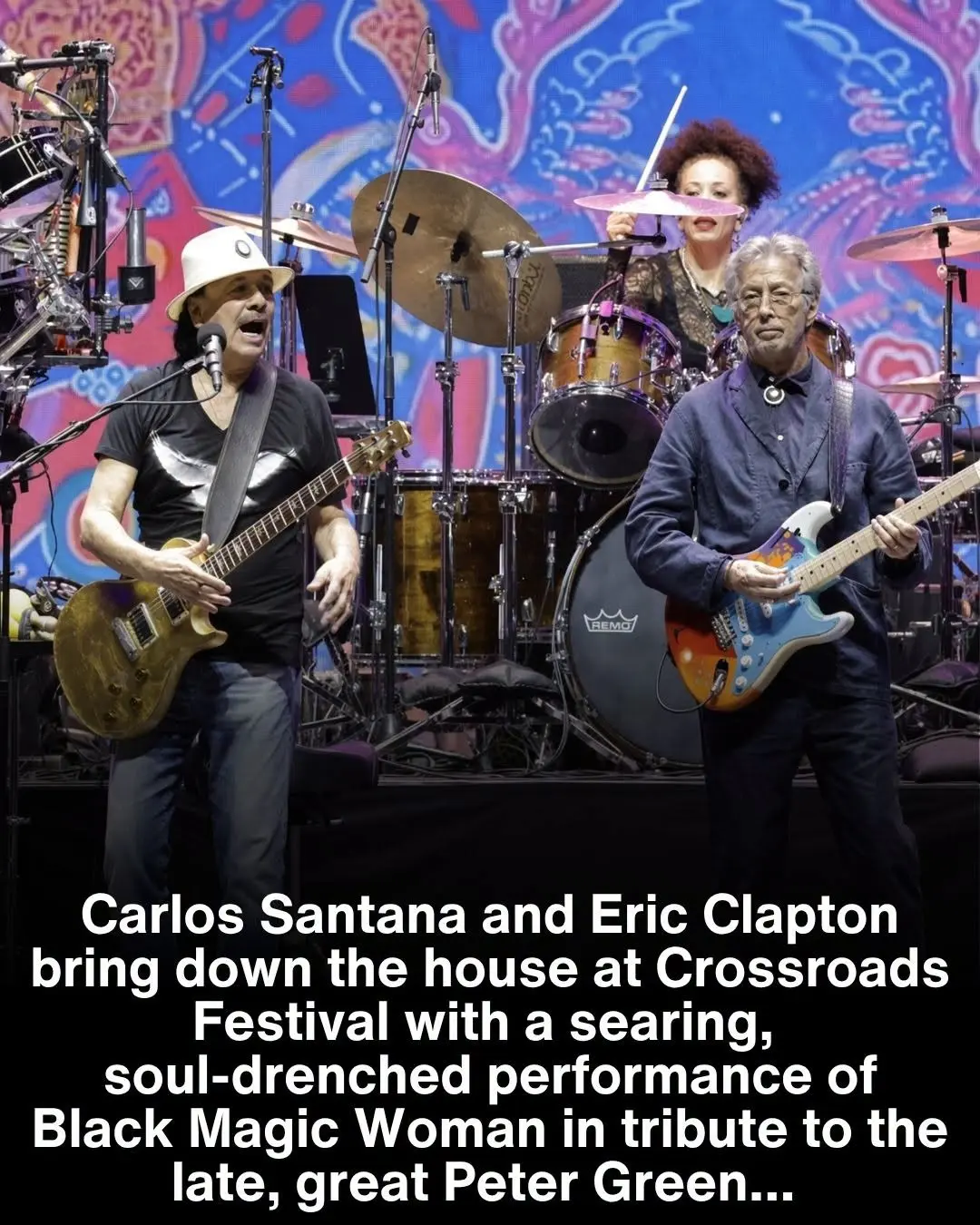
🎸🔥 “THE DOCTOR’S IN THE HOUSE!” — CARLOS SANTANA AND ERIC CLAPTON JOIN FORCES ON “BLACK MAGIC WOMAN,” TURNING A GUITAR SUMMIT INTO A POWERFUL SALUTE TO PETER GREEN ❤️🔥
Some musical performances are remembered because they are technically flawless.
Others remain unforgettable because of who is standing on the stage, what song they choose to play, and the history carried inside every note.
Put Carlos Santana and Eric Clapton together with “Black Magic Woman,” and suddenly all three elements collide.
This was never going to feel like an ordinary performance.
Santana and Clapton belong to a remarkably small group of guitarists whose sound can often be identified within seconds.
You do not necessarily need to see Santana to know when he is playing.
The sustained notes, melodic phrasing and warm, almost vocal quality of his guitar have been defining characteristics of his music for generations.
Clapton brings something different.
His musical vocabulary was shaped deeply by the blues, and his approach can shift from restraint to intensity without requiring unnecessary theatrics.
Two players.
Two unmistakable identities.
And between them stood the music of Peter Green.
 or casual listeners, “Black Magic Woman” is often associated immediately with Santana.
That association makes sense.
Santana's interpretation became one of the defining recordings of his career, transforming the song through Latin-rock rhythms, percussion and his signature guitar voice.
But the song's story began before Santana's famous version.
Peter Green wrote “Black Magic Woman,” and Fleetwood Mac first released the song in 1968, during the group's blues-oriented era.
That history makes any tribute involving Santana especially meaningful.
Santana did not simply perform a successful song.
His interpretation became part of the composition's extraordinary journey across generations and musical traditions.
The song moved from British blues into an entirely different sonic landscape without losing its emotional core.
That is one of the remarkable things about great songwriting.
A composition can survive transformation.
Different musicians can approach it from different directions and still reveal something authentic inside it.
Santana's version did exactly that.
The guitar became almost conversational.
Notes seemed to stretch and breathe.
Percussion gave the music a different pulse.
The arrangement became unmistakably Santana while still carrying Green's songwriting underneath.
Then imagine Clapton entering that conversation.
Suddenly the performance becomes more than a familiar classic being revisited.
It becomes a meeting of blues histories.
Clapton and Green emerged from overlapping British blues traditions, and both became associated with an era when young British guitarists were absorbing American blues and pushing it toward new audiences.
Green's reputation among musicians has always reached beyond commercial statistics.
His playing could be remarkably economical.
He did not need endless notes to create emotion.
Sometimes the space surrounding a phrase mattered as much as the phrase itself.
That restraint is one reason his influence survived.

That idea connects Green naturally to Santana and Clapton.
Neither guitarist built a legendary reputation merely by playing quickly.
Speed can impress.
Emotion lasts.
Santana's greatest notes often feel powerful because he allows them to remain in the air.
He bends into them.
He sustains them.
He gives listeners time to experience the sound.
Clapton has similarly spent decades demonstrating how a blues phrase can communicate more through timing and touch than through complexity alone.
When musicians with that level of experience trade phrases, the fascinating part is not competition.
It is listening.
One guitarist plays a line.
The other responds.
A phrase is repeated, altered or deliberately left unanswered.
The exchange becomes a conversation conducted without words.
That is why collaborations between elite musicians can become so compelling.
The audience is watching spontaneous decisions happen in real time.
No statistical measurement can fully explain what makes one bend feel perfect.
There is no scoreboard determining who “won” a guitar exchange.
The judgment is emotional.
Did the note land?
Did the musicians connect?
Did the audience feel something?
When the song itself carries the legacy of a musician such as Peter Green, those questions become even more meaningful.
Green died in 2020, but the continued performance of his compositions demonstrates the difference between a career and a legacy.
Careers end.
Songs keep moving.
They move through recordings.
Concerts.
Radio.
Streaming playlists.
Young musicians learning guitar.
Older fans revisiting albums.
And artists who reinterpret them decades later.
Every time “Black Magic Woman” is played, a piece of Green's musical imagination survives.
That does not diminish Santana's enormous role in making the song globally recognizable.
Instead, it demonstrates how music evolves.
One artist creates something.
Another hears possibilities inside it.
Another generation discovers the transformed version.
Then someone learns the history and travels backward to the original.
Suddenly a song becomes a bridge across decades.
That is what makes the Crossroads setting so appropriate.
The blues has always operated through musical inheritance.
Players learn from older players.
They borrow phrases.
They transform them.
They develop individual voices.
Then younger musicians learn from them.
The chain continues.
Clapton has spent much of his career openly acknowledging the blues musicians who shaped him.
Santana has similarly spoken through a guitar vocabulary that blends blues with Latin, rock, jazz and spiritual influences.
Peter Green occupied another point on that same enormous musical map.
Bring those names together through one song and the performance becomes almost historical by definition.
The crowd may arrive hoping for fireworks.
And there are certainly moments when legendary guitarists can deliver them.
But the deeper pleasure comes from recognizing the individual voices.
Santana does not need to sound like Clapton.
Clapton does not need to imitate Santana.
Neither needs to imitate Green exactly.
A meaningful tribute does not require copying the person being honored.
Sometimes the greatest respect is allowing the original music to continue living through new voices.
That is precisely what “Black Magic Woman” has done.
The composition has survived because it can absorb interpretation.
Its atmosphere remains recognizable even when the surrounding musicians change.
And when Santana begins playing those familiar lines, decades seem to collapse.
Listeners who first encountered the song on vinyl can stand beside people who discovered it through a phone.
Different generations recognize the same melody.
That is musical longevity.
There is also something particularly moving about veteran musicians honoring another veteran who is no longer there.
Time becomes impossible to ignore.
These artists have spent decades touring, recording and watching musical fashions appear and disappear.
They have seen contemporaries retire.
They have lost friends.
They have watched younger generations take over stages they once dominated.
Yet when the guitar is plugged in and the opening notes arrive, the years can temporarily disappear.
That is why performances like this can hit audiences differently from ordinary concerts.
People are not simply hearing a song.
They are hearing history overlap with the present.
Peter Green's original songwriting.
Santana's transformation of it.
Clapton's blues vocabulary.
All of those threads can meet inside a few minutes of music.
No long speech is necessary.
The guitars can say enough.
A sustained note from Santana.
A blues response from Clapton.
A familiar riff.
A crowd recognizing exactly what it is hearing.
And somewhere underneath everything, the composition Peter Green created decades earlier remains intact.
That may be the most beautiful part of the entire story.
Legends eventually leave the stage.
The music does not have to.
It survives whenever another musician considers it worth playing.
Whenever an audience still recognizes the opening phrase.
Whenever someone hears the song for the first time and asks who wrote it.
And whenever artists such as Carlos Santana and Eric Clapton use their own unmistakable voices to acknowledge the guitarist who helped begin the story.
For those few minutes, “Black Magic Woman” was more than a classic.
It became a conversation across generations.
Santana.
Clapton.
Green.
Three enormous guitar legacies connected through one song.
And as the final notes disappeared into the crowd, the message did not require words.
Peter Green may be gone.
But his music is still speaking. 🎸❤️
“The doctor’s in the house!” And when Carlos Santana and Eric Clapton stepped onto the stage together, everyone knew something special was about to happen.
At the Crossroads Festival, the two legendary guitarists joined forces for a fiery rendition of “Black Magic Woman,” paying tribute to the late Peter Green, the brilliant Fleetwood Mac guitarist and songwriter who helped make the song famous.
Santana brought his unmistakable, singing guitar tone, filling the air with emotion and warmth. Clapton answered with gritty blues phrasing, adding his own unmistakable character to the performance.
What followed was more than a showcase of incredible musicianship. It was a heartfelt salute from two guitar icons to another legendary player whose influence continues to echo through blues and rock.
As the notes soared and the crowd watched in awe, every bend, riff, and sustained note seemed to carry the same message: Peter Green’s music still lives on.
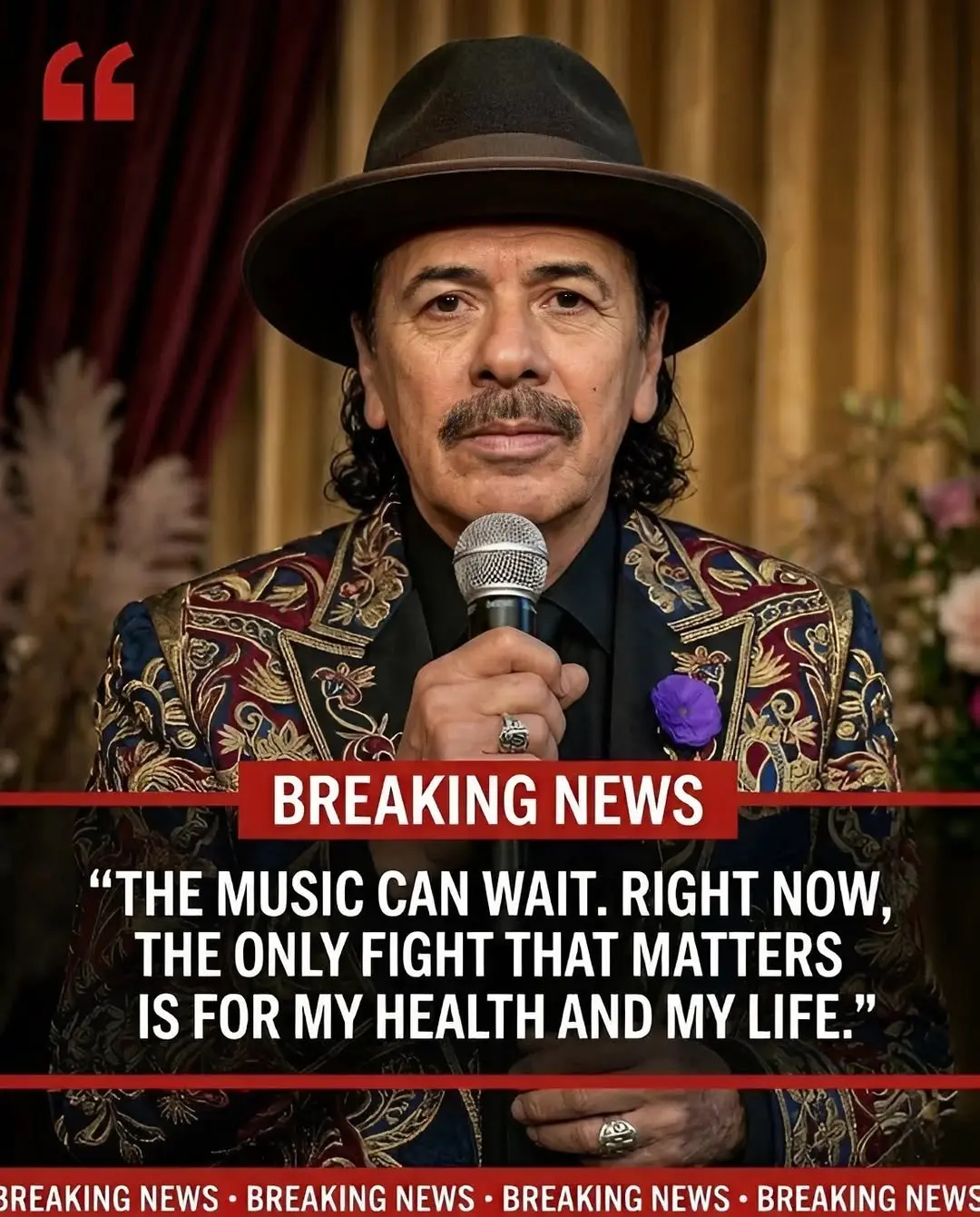
 For fans, Santana has never been merely a technically gifted guitarist.