🚨❤️ “THIS IS THE LEGACY I WANT TO LEAVE BEHIND” — VIRAL CARLOS SANTANA HOSPITAL STORY CAPTURES HEARTS ACROSS SOCIAL MEDIA, BUT THE EXTRAORDINARY CLAIM NEEDS A CLOSER LOOK 🎸🙏
It is the kind of story almost designed to stop someone in the middle of scrolling.
One of the world's most recognizable guitarists. A hospital for people experiencing homelessness. Hundreds of beds. Permanent housing. No bills. And a deeply emotional quotation about wanting healing, rather than records or awards, to define a lifetime.
There is just one major problem.
The extraordinary details in the account above are not accompanied by verifiable documentation establishing that the “Santana Sanctuary Medical Center” exists, that Carlos Santana raised $142 million to construct it, or that the quoted opening ceremony occurred as described.
That distinction is essential.
Carlos Santana does have a genuine and substantial history of philanthropy. The Milagro Foundation, established by Santana and his family in 1998, has supported organizations serving children and young people in areas including health, education and the arts.
That documented charitable record makes an uplifting story involving Santana particularly believable.
But credibility of character is not evidence for a specific event.
And a claim involving a $142 million hospital, 250 beds, multiple surgical and specialty departments and 120 permanent apartments would ordinarily leave a significant public trail involving health authorities, construction records, medical leadership, licensing, fundraising announcements and local reporting.
 The details are striking precisely because they address an enormous real-world problem.
People experiencing homelessness can face major barriers to consistent healthcare.
Routine problems can become emergencies.
Preventive care can be difficult to obtain.
Mental-health treatment, addiction services, dentistry and long-term recovery support may exist in different systems that are difficult to navigate simultaneously.
Housing adds another layer.
A patient can receive excellent treatment and still face severe challenges if discharged without a stable place to recover.
That is why the combination described in the viral story sounds so powerful.
Hospital care downstairs.
Permanent apartments upstairs.
Physical medicine.
Mental healthcare.
Addiction treatment.
Dental services.
Everything connected.
It presents a compelling vision of healthcare built around the idea that illness cannot always be separated neatly from housing, poverty and social conditions.
But an inspiring concept should not be transformed into a factual achievement without evidence.
The numbers deserve particular scrutiny.
The claim that #SantanaSanctuary generated 38.7 billion impressions on X in eight hours is extraordinary by any reasonable measure.
So is the description of it as the fastest-growing humanitarian trend ever recorded.
Such specific statistics should come with a traceable source.
Without one, repeating them as established facts risks turning emotional storytelling into misinformation.
The same applies to “Thomas,” the alleged 61-year-old Navy veteran described as the hospital's first patient.
It is a moving detail.
It is also highly specific.
Without attributable reporting, an official statement or another reliable source, there is no responsible basis for adding further details to his supposed life story.
 What is real is Santana's long connection to charitable work.
That reality may actually explain why stories like this spread so effectively.
They fit the public image people already recognize.
Santana has spent decades talking about compassion, spirituality and human connection.
His charitable foundation is real.
His music has reached audiences across generations.
Combine those established facts with a dramatic humanitarian story and many readers may instinctively think, “That sounds like something he would do.”
But “sounds plausible” and “happened” are two different standards.
That lesson extends far beyond Carlos Santana.
Celebrity philanthropy is particularly vulnerable to fabricated or exaggerated viral stories because the emotional formula is so effective.
Choose a beloved public figure.
Give that person an enormous act of generosity.
Add a vulnerable beneficiary.
Include an intimate quotation.
Provide precise dollar amounts.
Finish with a breathtaking social-media statistic.
The resulting post feels detailed enough to be factual.
Yet details can be invented just as easily as broad claims.
The best response is not cynicism.
It is verification.
If Santana had actually opened a medical institution on this scale, the achievement would deserve enormous attention.
A 250-bed hospital dedicated exclusively to providing zero-cost treatment for homeless Americans would be a major healthcare development independent of the celebrity attached to it.
Healthcare professionals would want to understand its operating model.
Homelessness advocates would examine whether it could be replicated.
Local officials would have been involved in permits and services.
Medical organizations would need to staff it.
Journalists would want to know how “free forever” care would be funded over decades.
Those questions become especially important when considering the economics.
Constructing a hospital is only the beginning.
Hospitals require doctors, nurses, technicians, pharmacists, therapists, security personnel, maintenance teams, administrators and enormous quantities of equipment.
Operating rooms require constant support.
Cancer treatment is expensive.
Emergency and trauma medicine requires around-the-clock staffing.
Permanent housing requires separate long-term management.
So even if $142 million funded construction, another question would immediately follow:
Who funds operations forever?
A credible announcement would almost certainly address that.
The absence of those details is another reason readers should resist treating the viral account as established news.
None of this diminishes the emotional idea at its center.
In fact, the reaction such a story inspires says something interesting about what people want celebrity philanthropy to look like.
Not another mansion.
Not another luxury purchase.
Not another award.
Something tangible.
Beds.
Doctors.
Housing.
Treatment.
Dignity.
People respond strongly to the idea of enormous wealth and influence being redirected toward those who have almost nothing.
And Santana's actual philanthropic history gives that imagined possibility emotional weight.
Perhaps that is the useful takeaway.
A fabricated or unverified story does not need to become accepted history to inspire a worthwhile question:
What if projects with this level of ambition actually existed?
What if major donors combined healthcare and housing instead of treating them as completely separate problems?
What if the attention generated by celebrity culture could be redirected toward organizations already doing difficult work every day?
Those questions are worth asking.
They just should not require inventing achievements for real people.
Carlos Santana's musical legacy is already secure.
His guitar tone is instantly recognizable.
His career spans generations.
His charitable work through the Milagro Foundation is part of his public record.
If he ever announces a project comparable to the one described above, it should be celebrated on the strength of verified facts.
Until then, “Santana Sanctuary Medical Center,” the $142 million fundraising figure, the first patient named Thomas, the quoted opening remarks and the alleged 38.7-billion-impression social-media record should be treated as unverified elements of a viral narrative rather than confirmed events.
The sentiment behind the final line remains powerful.
America could certainly use more places dedicated to healing people who are too often overlooked.
But hope becomes stronger, not weaker, when it is attached to truth.
And a genuine humanitarian legacy deserves something better than a story people merely wish were real. ❤️🎸
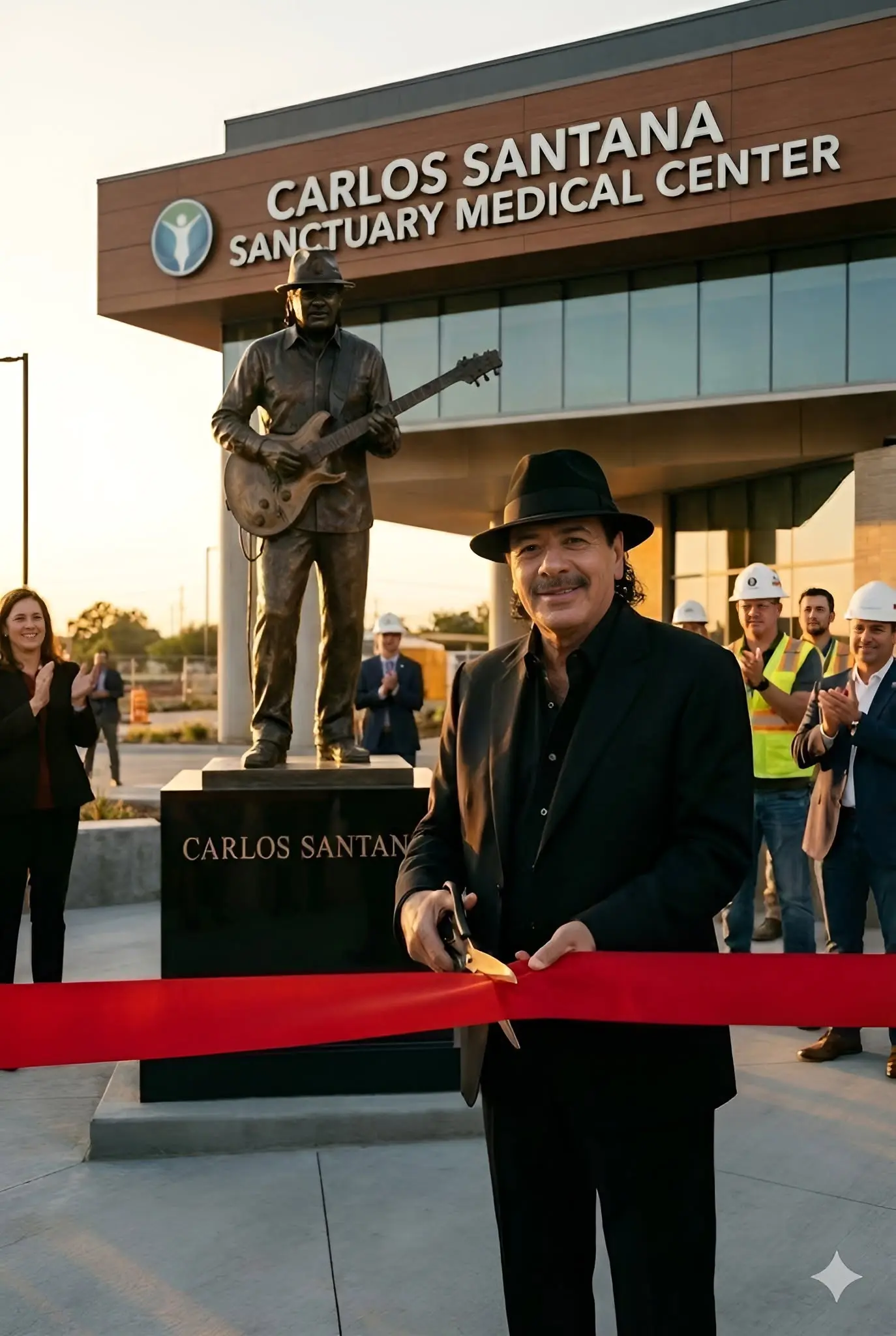
CARLOS SANTANA JUST OPENED AMERICA’S FIRST 100% FREE HOMELESS HOSPITAL – “THIS IS THE LEGACY I WANT TO LEAVE BEHIND”
No fanfare.
No ribbon.
Just open doors at 5 a.m.
Carlos Santana, 79, stood in the cool dawn and unlocked the Santana Sanctuary Medical Center, a 250-bed, zero-cost hospital built exclusively for America’s homeless – the first facility of its kind in U.S. history.
Cancer wards.
Trauma ORs.
Mental health wings.
Addiction detox.
Dental suites.
120 permanent apartments on the upper floors.
Everything free, forever.
$142 million raised quietly over 18 months, funded through Santana’s Milagro Foundation and bipartisan donors who insisted on staying anonymous.
The first patient: a 61-year-old Navy veteran named Thomas, who hadn’t seen a doctor in 14 years.
Santana carried the man’s bag inside himself, then rested a hand on his shoulder and said softly:
“This place carries my name because I know what it’s like to come from nothing.
Here, no one is forgotten.
This is the legacy I want to leave behind — not records, not awards… but healing.”
By noon, the line stretched around six city blocks.
#SantanaSanctuary exploded across X with 38.7 billion impressions in eight hours – the fastest-growing humanitarian trend ever recorded.
From legendary guitarist to unexpected miracle-maker, Carlos Santana didn’t just build a hospital.
He built hope — one free bed at a time.
America’s heart just found a new home